
Replacing Windows in a Dayton Historic District: Certificates, Reviews and Options
Dayton's housing is old. The median home in the city was built in 1951, and more than a third were built before 1940, according to Census estimates. A good share of those homes sit in locally designated historic districts. If your home is in one, you cannot simply pick a window from a catalog and schedule the install. Exterior changes, windows included, need a Certificate of Appropriateness (COA) from the city first.
The good news is that the process is usually simpler than people expect, especially when the new windows match what is there now. This guide explains how it works in the City of Dayton, how Centerville handles its preservation district, and how to plan a window project that has a reasonable chance of approval.
Rules and staff change. This is general information, not legal advice. Before you order windows, confirm the requirements for your address with the City of Dayton Historic Preservation Officer, your own city's planning office, or an attorney.
Does Dayton have historic districts?
Yes. In a May 2022 post, the City of Dayton said it currently has 13 locally designated historic districts. The city's Historic Districts Information page shows local districts including Five Oaks, Grafton Hill, Historic Inner East, McPherson, Old Dayton View, Oregon, South Park, Wolf Creek and Wright-Dunbar, and St. Anne's Hill is also a designated district. (Preservation Dayton gives a count of 14, so expect some variation depending on the source and date.)
Local historic zoning comes in levels. According to the city:
- HD-1 protects a building's overall form or style, its massing or size, and its fenestration, meaning its windows.
- HD-2 is the most restrictive and requires a COA for any exterior work.
- HD-3 requires a COA only for demolition.
National Register listing is a different thing from local zoning. Dayton View, Huffman, Kossuth Colony and other areas appear on the National Register, and Oakwood's Schantz Park and Miamisburg's Market Square are listed districts too. National Register status alone generally does not control what a private owner does with private money, but local rules can. Ask your city which applies to your address.
Minor vs major Certificate of Appropriateness
Dayton sorts window work into two tracks:
| Type of window work | Review | Who decides |
|---|---|---|
| Replacing windows with ones that match the existing design | Minor COA | Historic Preservation Officer (staff) |
| Adding, removing or changing the size of window or door openings | Major COA | Landmark Commission |
| Changing the window layout of a facade | Major COA | Landmark Commission |
Sources: City of Dayton blog (May 2022) and St. Anne's Hill Historic Society.
The city describes routine work as requiring "little more than a phone call or an email" to the Historic Preservation Officer, and says a minor COA "can typically be processed and sent out in the mail to you the same day." The St. Anne's Hill Historic Society notes there is no fee for a COA. Major COAs go on a Landmark Commission agenda, so they take longer and need more planning.
The Historic Preservation Officer's contact information is on the city's Historic Districts Information page. At the time of writing, the office phone listed there is (937) 333-4271.
What does "matching the existing design" mean for windows?
Dayton's districts follow a design guide called Blueprint for Rehabilitation. We were not able to review its window language directly, so we cannot tell you exactly which materials are approved. In general, reviewers look at how a window reads from the street:
- The operating type (a double-hung stays a double-hung).
- The size of the opening and how the window fills it.
- The grid or muntin pattern, such as one-over-one or six-over-six.
- Sash and frame proportions, including how wide the frame looks.
- Trim, sills and brick molding around the window.
Can you use vinyl windows in a Dayton historic district? We do not know for any particular house, and nobody should promise it before the Historic Preservation Officer weighs in. Ask before you order. Bring the product brochure and a photo of the existing window to the conversation.
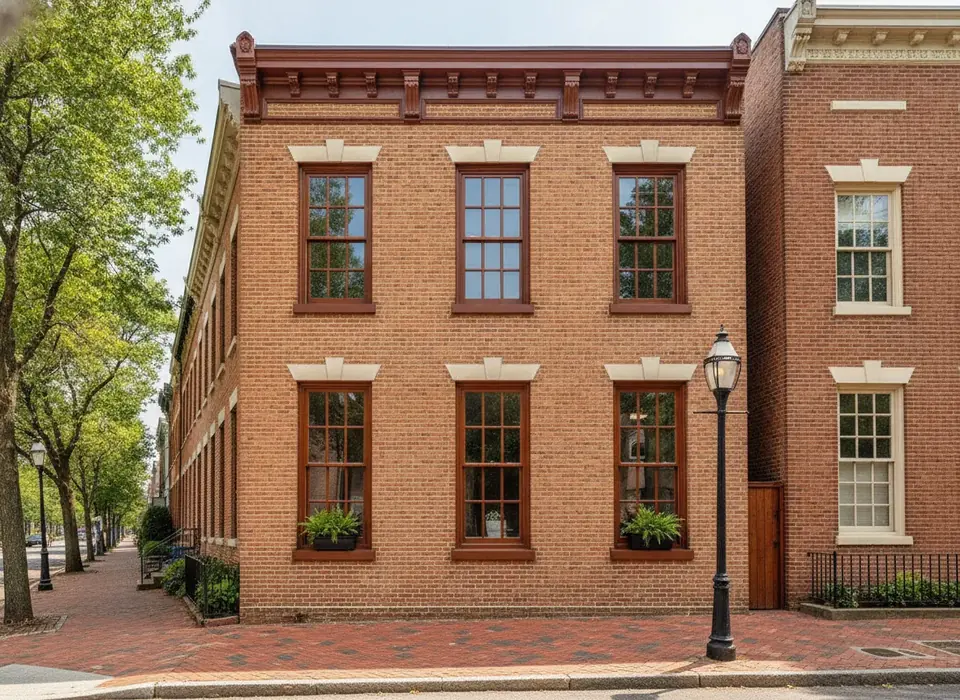
Centerville's Architectural Preservation District
Centerville has its own Board of Architectural Review, a seven-member board that meets monthly and covers the Architectural Preservation District and designated landmarks. In April 2023 the board approved replacement windows on the condition that each one "follow the existing grid pattern." The city revised its Design Review Criteria in December 2022. If your home is in the district, check with Centerville's planning department before ordering. See our Centerville window replacement page for more on local housing.
Other nearby towns, including Oakwood and Miamisburg, have historic neighborhoods but different rules. Call your city's planning or zoning office to ask whether any review applies.
Should you repair or replace original wood windows?
In a historic house, repair is often worth a serious look. Old-growth wood sashes can last a long time when glazing, paint and sash cords are maintained, and repairing them avoids the design questions that come with replacement. Pairing repaired sashes with storm windows can help with drafts. Our storm windows vs replacement windows guide compares costs.
Replacement makes more sense when sashes are badly rotted, previous replacements were already non-original, or the frames are failing. Our historic window replacement and repair page covers both paths, and the wood and clad-wood windows page explains the materials installers often propose for older homes.
Lead paint is almost certain
Nearly every home in Dayton's historic districts was built long before 1978. That means the window company must be an EPA Lead-Safe Certified Firm, and window replacement does not count as minor repair under EPA's rule. Read lead-safe window replacement before you collect quotes.
A step-by-step plan for a historic-district window project
Confirm your district and zoning level
Check the city's historic district map or call the Historic Preservation Officer.
Photograph and measure the existing windows
Note the grid pattern, operating type and trim on each elevation.
Get quotes that describe the design
Ask installers to put the material, profile and grid pattern in writing.
Talk to the Historic Preservation Officer before you order
Share the product details and ask whether a minor COA fits or a major COA is needed.
Get the COA in hand, then schedule
Don't let anyone order windows or start work before approval. Check building permit requirements too, especially if openings change.
Ready to price it? Use the free quote form and mention that your home is in a historic district. Independent local installers who reply can tell you whether they handle COA paperwork, though the approval decision belongs to the city.
Questions people ask
Do I need permission to replace windows in a Dayton historic district?
Usually yes. Homes in Dayton's locally designated districts need a Certificate of Appropriateness for window work covered by their zoning. Matching-design replacements typically need a minor COA from the Historic Preservation Officer; changing openings needs a major COA from the Landmark Commission.
How long does a minor COA take in Dayton?
The city says a minor COA can typically be processed and mailed the same day. Major COAs go to the Landmark Commission and take longer.
Can I put vinyl windows in a historic district home?
It depends on the property and the review. Don't order until the Historic Preservation Officer, or in Centerville the Board of Architectural Review, has looked at the specific product.
Is there a fee for a Certificate of Appropriateness in Dayton?
The St. Anne's Hill Historic Society says there is no fee for a COA. Confirm with the city, and note that a building permit, if needed, is separate.